

‘A Church Romance: Mellstock about 1835’ by Thomas Hardy (1840-1928)
She turned in the high pew, until her sight
Swept the west gallery, and caught its row
Of music-men with viol, book and bow
Against the sinking sad tower-window light.  4

She turned again; and in her pride’s despite
One strenuous viol’s inspirer seemed to throw
A message from his string to her below,
Which said, ‘I claim thee as my own forthright!’  8

Thus their hearts’ bond began, in due time signed
And long years thence, when age had scared Romance,
At some old attitude of his or glance
That gallery-scene would break upon her mind,  12
With him as minstrel, ardent, young and trim,
Bowing ‘New Sabbath’ or ‘Mount Ephraim’.
Considering the Poem
This poem is about times that have passed at the moment Hardy writes. It describes an event, really just a fleeting moment as in a dream, in a country church in about 1835, seventy years or more before the publication of the poem.
Hardy quickly fixes the basic viewpoint in this sonnet-form lyric. In the all-knowing role of an external narrator, he focuses first on the consciousness of a young woman (actually, he’s writing about the courtship of his mother and father) as she exchanges a romantic look with the musician in the gallery (1-4), and then, in the last six lines, he sustains the viewpoint to compare this youthful, intuitive moment with the later insightful memories, after years of marriage, that renew that original impulse of love (11-14).
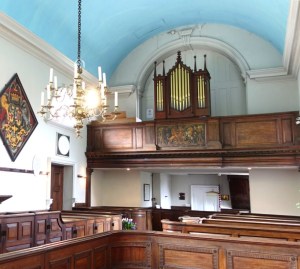
It could almost be used as a scene in one of his novels. Her youthful motives may not be all that devotional – indeed, Hardy enjoys telling us about her straining against the ‘high pew’ as she squirms round to look, not eastwards, but the wrong way, to the ‘west gallery’ where the musicians play the hymn tunes mentioned in the final line.
Hardy also shows us that, however dominant her romantic feelings may at that moment be, her life is held securely in the physical and social frame of the small, particular, ordinary church and that, by this, her life is (and will always be) given dignity and value.
 Christian Poetry Considered