

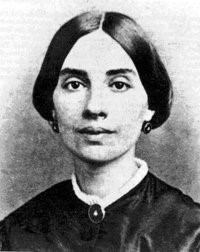
‘Farewell’ by Emily Dickinson (1830-1886)
Tie the strings to my life, my Lord
Then I am ready to go!
Just look at the horses  -
Rapid! That will do!     4

Put me in on the firmest side,
So I shall never fall;
For we must ride to the Judgement,
And it’s partly downhill.     8

But never I mind the bridges,
And never I mind the sea;
Held fast in everlasting race
By my own choice, and thee.   12

Good-by to the life I used to live,
And the world I used to know;
And kiss the hills for me, just once;
Now I am ready to go!
Well tried through .      14
Considering the Poem
The speaker of this lively poem addresses “her Lord” directly and in the familiar terms she would use with a relative preparing the horses, the carriage and, in fact, the speaker (1-2), for a shared, family expedition. The whole poem is colloquial and seems (until you notice the organised verse form and the planning, for instance in the final line’s echo of line 2) like artless speech: the exuberance (2, 4); the plain vocabulary; most of all, the unfolding of the sentences which often grow naturally by conjunction (then, so, but, and), as in casual speech.
Perhaps the poem is about the end of life but any renewing change to the life she ‘used to live’ (13) might be suggested, as long as that change involves the headlong momentum and dangerous patches – ‘partly downhill’ (8) – that her personal journey ‘to the Judgement’ (7) entails.
 Christian Poetry Considered