

‘Bury Me in a Free Land’ by Frances Ellen Watkins Harper (1825-1911)
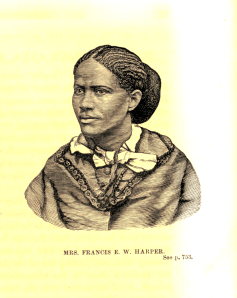
Make me a grave where’er you will,
In a lowly plain or a lofty hill,
Make it among earth’s humbled graves,
But not in land where men are slaves.

I could not rest if around my grave
I heard the steps of a trembling slave:
His shadow above my silent tomb
Would make it a place of fearful gloom.  8

I could not rest if I heard the tread
Of a coffle gang to the shambles led.
And the mother’s shriek of wild despair
Rise like a curse on the trembling air.

I could not sleep if I saw the lash
Drinking her blood at each fearful gash,
And I saw her babes torn from her breast,
Like trembling doves from their parent nest.  16

I’d shudder and start if I heard the bay
Of blood-hounds seizing their human prey,
And I heard the captive plead in vain
As they bound afresh his galling chain.

If I saw young girls from their mother’s arms
Bartered and sold for their youthful charms,
My eye would flash with a mournful flame,
My death-paled cheek grow red with shame.  24

I would sleep, dear friends, where bloated might
Can rob no man of his dearest right;
My rest shall be calm in any grave
Where none can call his brother slave.

I ask no monument, proud and high
To arrest the gaze of passers-by,
All that my yearning spirit craves,
Is bury me not in a land of slaves.  32
Considering the Poem
Frances Harper wrote this poem for an abolitionist paper, ‘The Anti-Slavery Bugle’. It was published three years before the start of the American Civil War. Harper, the daughter of freed slaves, was active in the abolitionist cause, writing polemical poems that affect a reader by means of unusual poetic viewpoints – here, the speaker in the poem addresses us from the grave – and through clear expressions of emotion that help her make a direct relationship with the reader.
In his letter to the Galatians, Paul says that: “There is neither Jew nor Greek, there is neither bond nor free, there is neither male not female for ye are all one in Christ Jesus’ (3: 28). All have equal standing and worth in the eyes of God and all human classifications by race, by social position, by ethnicity are superficial and should be as meaningless to a Christian as they are to God. ‘Bury me in a Free Land’ is an example (among many in literary history) of the power that Christianity can lend to the pursuit of justice and truth.
Sometimes poets speak as themselves in a poem. Sometimes they adopt a persona with a particular voice. As we all know, in life, the voice, its tone and manner, has an effect on a listener and, as listeners, we always draw conclusions about the speaker from her or his voice. The choice a poet makes about who is to be the speaker in a poem is important: it affects the whole atmosphere of what’s written. Here the voice of the poem seems to be Frances Harper herself. When the voice of the poem is the poet, not an adopted persona, the poet is usually, as in this case, hoping to create direct, personal, honest communication with us, the readers.
The energetic, challenging and sometimes fierce tone of the poem does come from the constant, direct address of its unwavering voice. This directness is amplified by the two imperatives, or commands, like sudden electric pulses, that jolt the poem into life (1, 3).
Frances Harper, like all good poets, takes care of the details and makes little words work hard. The repetition of the word ‘tremble’ (6, 12, 16) has an incremental effect that gives extra power to the poem, crystallising its signature feeling of personal fear. Some of the word choices are perhaps predictable (‘wild despair’ [11], ‘youthful charms’ [22], and so on) but this may not altogether be a bad thing since the poet’s aim is to communicate a clear message efficiently and with the minimum of fuss, friction or misunderstanding, to a general audience.
The viewpoint of the poem is sensational, macabre and arresting. The poet speaks to us as her deceased but still sensing self, longing to lie in a place from which she cannot hear the ugly noises and sights of slavery: ‘the steps of a trembling slave’ (6), a mother’s anguish at a child’s suffering (11-16, 21-24), cruel punishment and pursuit (13-14, 17-20), and the movement of a chained (‘coffled’) gang being herded along to death (10).
The poem is a challenge to the reader to help to re-make the world as a fit place for free life, and peaceful death, but in the final two verses, the tone changes, replacing the surreal, unnerving view from the grave with a public, heartfelt plea to the ‘dear friends’ who have joined her in the intimate act of reading her words. The plea repeats the order from the first verse which, really, is the whole idea of the poem: ‘bury me not in a land of slaves’ (32).
Where is the slaveless land? Frances Harper could be asking to be buried in a free land far away but, surely, she is hoping, perhaps even expecting, that her own land will be free before she dies and that her Christian poem and those who have read it will have played a part in the changing and renewal of the world.
Frances Ellen Watkins Harper died on February 22nd 1911 and was buried in Philadelphia.

 Christian Poetry Considered