

‘To my Dear and Loving Husband’ by Anne Bradstreet (1612-1672)
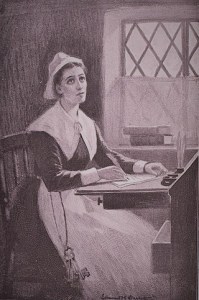
If ever two were one, then surely we.
If ever man were loved by wife, then thee.
If ever wife was happy in a man,                       3
Compare with me, ye women, if you can.
I prize thy love more than whole mines of gold,
Or all the riches that the East doth hold.   6
My love is such that rivers cannot quench,
Nor ought but love from thee give recompense.
Thy love is such I can no way repay;               9
The heavens reward thee manifold I pray.
Then while we live, in love let’s so persevere
That when we live no more, we may live ever.
Considering the Poem
There are many short lyric poems in literature about the tempestuous excitements and disappointments of romantic love. This poem is not one of them. Its subject is something rarer, in literature, if not in life: the Christian ideal of married love, a love that is created because the couple ‘persevere’ (11).
Anne Bradstreet testifies here to the value of a married love which is made over many years of shared life and which has been tempered, proven and strengthened in the fires of mutual experience. Her poem reminds us of its biblical background straight away: ‘If ever two were one, then surely we’. Genesis tells us: ‘Therefore shall a man leave his father and his mother, and shall cleave unto his wife: and they shall be one flesh’ (2: 24). Paul’s Letter to the Ephesians repeats the ideal using the nearly the same words (5: 31) and there are many other New Testament references both direct and indirect to the aspiration of Christian marriage.
The poem is not a piece of abstract philosophy, though. It presents and explains the ideal in terms of a particular case, the author’s own case. In fact, the poem is a short conditional argument (in the form ‘If A, then B’) that asserts and then illustrates, explains and proves Anne Bradstreet’s claim that oneness is the essence of her marriage.
The lyric is in three four-line sections, or quatrains. The first makes three opening claims in conditional form, each using one line of verse, and ends with a challenge to other ‘women’ (4) who may doubt her assertions. The next quatrain (5-8) explains the evidence that the completeness of her love for her husband justifies the claims she has made in the first four lines. The underlying comparison is the second quatrain is one between worldly riches and the emotional and spiritual wealth of her love for her husband: neither ‘mines of gold’ nor the ‘riches’ of the exotic East could be valued more highly. In the final four lines, in a touching change of tone and posture, the poet turns to face her husband and to state, plainly and directly, what she owes him (9), to make a little prayer for him (10) and to hope aloud that ‘when we must live no more, we may live for ever’.
A Puritan in faith, Anne Bradstreet here, suitably, gives a pure, honest, simple and clear poetic expression to her experience of married love.
 Christian Poetry Considered