

‘A Lullaby’ by Janet Lewis (1899-1998)
This material is used by permission of Ohio University Press: http://www.ohioswallow.com Christian Poetry Considered is grateful to Ohio University Press for its kind permission.
Lullee, lullay,
I could not love thee more
If thou wast Christ the King.
Now tell me, how did Mary know
That in her womb should sleep and grow
The Lord of everything?          6

An angel stood with her
Who said: “That which doth stir
Like summer in thy side
Shall save the world from sin.
Then stable, hall, and inn      11
Shall cherish Christmas-tide.”

Lullee, lullay,
And so it was that Day.
And did she love Him more
Because an angel came
To prophesy His name?
Ah no, not so,                                18
She could not love Him more,
But loved Him just the same.
Lullee, lullay.
Considering the Poem
What the modern American poet, Janet Lewis, does here is to reinvent the medieval ballad ‘Endris Night’ which was the subject of last week’s article. She re-invents it by concentrating its essence; this entails leaving some aspects of the earlier poem behind and intensifying some of its other elements.
There are quite a few medieval poems that use a lullaby refrain like the one in ‘This Endis Night’, but last week’s poem seems to be a formative model for Janet Lewis. The medieval poem is in ballad form but it has a lyrical and musical quality that ballads, concentrating as they do on telling a story in verse, do not usually have. The lyrical delicacy of ‘Endris Night’ arises from its musical qualities, its steady rhythms, its gentle and melodic refrain, its rhymes and sound patterns. These musical features are carried forward and intensified in Janet Lewis’s poem and are the primary means by which the poet communicates Mary’s unconditional love for her child, Jesus. In fact, Janet Lewis excises completely the narrative and ballad features of the old poem in order to remove anything that would distract us from the lyrical quality of ‘A Lullaby’ and the moral and spiritual beauty of what it describes.
As part of this intensification of the musical and lyrical features that the poet found in ‘Endris Night’, she makes a sparing but elegant use of rhyme and other graceful effects of sound: a harmonious feeling, for instance, is created by alliteration (especially in the repeated /s/ sounds in the second verse). But most importantly, as you’d expect in a lullaby, the rhythms matter. The poem carries forward the steady rhythms of the medieval poem but transforms them into an hypnotic, rocking rhythm based on units of two syllables, the first unstressed and the second stressed – in literary terms, an iambic rhythm. The first use of the refrain ‘Lullee, lullay’ sets this pattern and the poem sticks to it with an unusual intensity. The only major deviation from the pattern is made for a good, dramatic reason: just before the final statement of the poem, Lewis stops the rocking rhythm momentarily in a line that is meant to stop us in our tracks as the poet addresses us directly (19) and stops us jumping to a conclusion that she does not wish us to reach.
As was the case in the old ballad, the musical features make the simple vocabulary of the poem shine with significance by communicating vividly the qualities of delicacy and grace in Mary’s love.
Janet Lewis also carries forward and intensifies a part of the subject matter of the earlier poem – its interest in the question of whether there is any difference between worldly and divine love. While the poor mother Mary in the medieval source poem worries that she cannot give the divine Jesus the material goods he should have, in Lewis’s poem this kind of anxiety is left behind. The dominating idea in ‘A Lullaby’ is Mary’s human love for the child. Happening though it is in a poor and imperfect world, this human, maternal love is as true and pure as any love could ever be. The fact that an ‘an angel came/ To prophesy His name’ (17-18) does not mean she should or even ‘could love him more’ (20). His divine origins do not require more than the maternal love she can offer.
So, what Janet Lewis has made here is a celebration of the nature of motherly love. She insists that the quality of this love is not different from the quality of divine love. It is complete, pure and unconditional, perhaps like no other worldly love. Mary’s human love, as it is represented in this elegantly lyrical poem, is an embodiment of the perfect, self-sacrificing and unconditional love that we understand divine love to be.
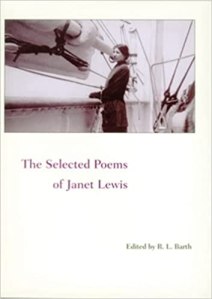
The Selected Poems of Janet Lewis: Amazon.co.uk: Lewis, Janet, Barth, R. L.: 9780804010238: Books
 Christian Poetry Considered