

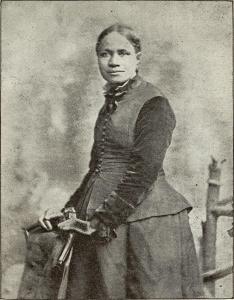
‘To the Union Savers of Cleveland’ by Frances Ellen Watkins Harper (1824-1911)
Men of Cleveland, had a vulture
Sought a timid dove for prey
Would you not, with human pity,
Drive the gory bird away?  4

Had you seen a feeble lambkin,
Shrinking from a wolf so bold,
Would ye not to shield the trembler,
In your arms have made its fold?

But when she, a hunted sister,
Stretched her hands that ye might save,
Colder far than Zembla's regions,
Was the answer that ye gave.  12

On the Union's bloody altar,
Was your hapless victim laid;
Mercy, truth, and justice shuddered,
But your hands would give no aid.

And ye sent her back to the torture,
Robbed of freedom and of right,
Thrust the wretched, captive stranger.
Back to slavery's gloomy night.  20

Back where brutal men may trample,
On her honor and her fame;
And unto her lips so dusky,
Press the cup of woe and shame.

There is blood upon our city,
Dark and dismal is the stain;
And your hands would fail to cleanse it,
Though Lake Erie ye should drain.  28

There's a curse upon your Union,
Fearful sounds are in the air;
As if thunderbolts were framing,
Answers to the bondsman's prayer.

Ye may offer human victims,
Like the heathen priests of old;
And may barter manly honor
For the Union and for gold.  36

But ye can not stay the whirlwind,
When the storm begins to break;
And our God doth rise in judgment,
For the poor and needy's sake.

And, your sin-cursed, guilty Union,
Shall be shaken to its base,
Till ye learn that simple justice,
Is the right of every race.  44
Considering the Poem
Poetry can be put to many uses, not least of which is polemic of one sort or another. Here, as in much of her poetry, Frances Ellen Watkins Harper makes a powerful attack on the moral corruptions of slavery in a poem that was published in the ‘Anti-Slavery Bugle’ in February 1861 on the very eve of the American Civil War. Thus, like all the most effective polemical literature, it was timely. The immediate stimulus for the poem was the treatment of the runaway slave, Sara Lucy Bagby (1843-1906) who, under the stipulations of the ‘Fugitive Slave Act’, having been captured in Cleveland, Ohio, was returned to slavery in Virginia.
The poet’s dominant aim here – maybe her only aim – is to shame the politicians and citizens of Cleveland by making them understand their own moral failure. She starts this process in the first two verses quite gently by appealing to their better nature: surely, she asks, they would have intervened had they seen a vulture destroy a dove or a wolf threaten a lamb. The images here have a persuasive or rhetorical purpose, of course: she knows that common humanity demands that they would intervene and should therefore have stepped in to save not an animal but another human being, ‘a hunted sister’ (9).
This, and what is to follow, is based on Harper’s Christian beliefs. The power of her polemic is provided by the Christian understanding that all individuals are spiritually equal, of equal value to God, and that the mission of Jesus to the poor and the outcast was the essence of his work in the world. As Luke records, Jesus said that the ‘Spirit of the Lord … hath anointed me to preach the gospel to the poor; he hath sent me to heal the brokenhearted, to preach deliverance to the captives, and recovering of sight to the blind, to set at liberty them that are bruised’ (4:18). Perhaps Harper had this biblical text in mind when thinking about the bruised captive, Sara Bagby, and the moral blindness of her foes.
The power of the polemical attack on the Union and on the Clevelanders, in particular, is amplified as we move into the main body of the poem. Harper increases the ferocity of her polemic by making an under-structure in the verse based on the rhetorical technique of antithesis. On one side of the antithesis are the abstract nouns that name the ideals of democratic, Christian life: mercy (15), truth (15), justice (15, 43), freedom (18), right (18, 44), honor (22, 25) and fame (22), by which Harper means reputation. These moral abstractions march through the poem rather as they march through American and English literature as a whole.
Set in antithesis to these concepts, and juxtaposed against them, verse by verse, is a set of emotive, concrete images of cruelty and physical unease: the frozen Siberian island of Zembla (11), a sacrilegious human sacrifice (13, 33), torture (17), a fearsome darkness (20), a trampling injury (21), and blood stains marking an apparently civilized city (25-26).
All this culminates in the sustained image of a noisy storm (37-44) which Harper uses to provide a climax to the poem. Much in the manner of an Old Testament prophet to whom a cataclysmic future is real and its punishment imminent, the poem ends with retribution for the ‘sin-cursed, guilty Union’ (41) which, in the poet’s view, as the ultimate cause of the capture and sending back of the runaway, is the justified target of the poem’s moral attack.
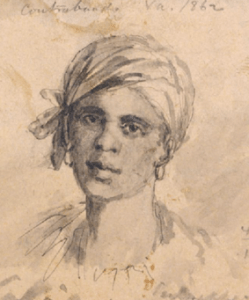
As for Sara Lucy Bagby (above), she eventually got across the Ohio river to Cleveland. She settled there for the rest of her life, dying in 1906.
KINDLE £2. 36 (at time of writing)
 Christian Poetry Considered