

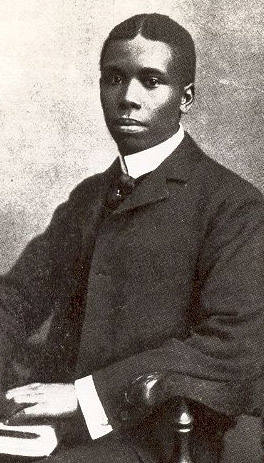
‘Sympathy’ by Paul Lawrence Dunbar (1872-1906)
I know what the caged bird feels, alas!
When the sun is bright on the upland slopes,
When the wind stirs soft through the springing grass,
And the river flows like a stream of glass;
When the first bird sings and the first bud opes,
And the faint perfume from its chalice steals –
I know what the caged bird feels!         7

I know why the caged bird beats his wing
Till its blood is red on the cruel bars;
For he must fly back to his perch and cling
When he fain would be on the bough a-swing;
And a pain still throbs in the old, old scars
And they pulse again with a keener sting -
I know why he beats his wing!            14

I know why the caged bird sings, ah me,
When his wing is bruised and his bosom sore,
When he beats his bars and he would be free;
It is not a carol of joy or glee,
But a prayer that he sends from his heart’s deep core,
But a plea, that upward to Heaven he flings -
I know why the caged bird sings!      21
Considering the Poem
Perhaps the refrain of this poem, and particularly the version in the final line, seems familiar?
This might be because it was chosen by Maya Angelou for the title of her autobiography or it might be because the poem and its author, who wrote novels, short stories, journalism, lyrics and essays as well as poetry, have always been well-known everywhere. Paul Lawrence Dunbar even visited England to give readings and lectures about his work.
Dunbar has two very distinct styles in his poetry. This poem is in what we might think of as his conventional approach: the language is literary (sometimes self-consciously so, as in “fain”) and all the traditional stylistic devices of poetry from alliteration to techniques of versification, and most stops in-between, are deployed to good effect. It also looks as if Dunbar knew the traditional lyric, seven-line ‘Ballade’ style that poets like Chaucer, and others even further back in time, sometimes used and, as does Dunbar here, adapted. The poem, all things considered, is a good example of what we might call Dunbar’s European style.,

His other mode of writing employed the African-American dialect English of the late nineteenth and early twentieth century. The vocabulary he used for these poems celebrated his culture in a completely radical and uncompromising way: he used it for, and made of it, a successful art form. Readers will remember Dunbar’s powerful and fascinating poem, ‘When Malindy Sings’ which has already been considered here in our collection of Christian poems.
The subject of ‘Sympathy’ is announced in the title and is sustained through the verses with no irrelevance or digression: the governing image is of the caged bird and this is used (although its focus changes from verse to verse) from start to finish as a structural metaphor to explain the suffering, anger and frustration generated by living in a society that imprisons a person in its rules, assumptions and practices. Sympathy, of course, is a moral, spiritual and psychological state and Dunbar here is choosing to present the suffering of the unfree psychologically and – by the final verse – spiritually and morally, rather than in political terms.
In the first verse the frustration is expressed by the contrast between the living, free world of natural growth and light and the cruel restrictions that the caged bird ‘feels’ (1). In the next verse the focus changes from feeling to action, but it’s self-harming frustration and anger that here dominates as Dunbar builds up a shockingly detailed account of the physical injuries the bird inflicts on itself as it beats its wings against the cage’s bars (8-9). At this point in the poem, the speaker begins to know not just ‘what’ (7) but ‘why’ the caged animal beats his wing’ (14). It is turning its frustrated fury in upon itself in a horrifying and hopeless distortion.
Poets tend to think of birds’ song as something to do with self-expression. It’s this poetic idea that Dunbar is using when he tells us why the bird sings: it is not for joy; it’s for sorrow. The singing is a heart-born ‘prayer’ and ‘plea’ that the caged animal ‘flings’ upward to Heaven, the verb expressing a sudden, forceful action and one that, finally, releases the sufferer’s energy, not reflexively and harmfully into itself, but outwards into the the world and beyond. The metaphor reaches a timely maturity and transformation at this climactic point in the poem: we can see that, in finishing his poem and sending it out to God and into the world, Paul Lawrence Dunbar, the caged poet, is – literally – expressing his ‘song’.
It is free. God heard it as a prayer. We are reading it.

£0.15 (at the time of writing)
£9.96 (at time of writing)
 Christian Poetry Considered