

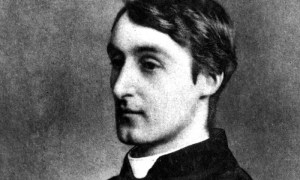
‘Felix Randal’ by Gerard Manley Hopkins (1844-1889)
Felix Randal the farrier, O is he dead then? my duty all ended,
Who have watched his mould of man, big-boned and hardy-handsome
Pining, pining, till time when reason rambled in it, and some
Fatal four disorders, fleshed there, all contended?    4

Sickness broke him. Impatient, he cursed at first, but mended
Being anointed and all; though a heavenlier heart began some
Months earlier, since I had our sweet reprieve and ransom
Tendered to him. Ah well, God rest him all road ever he offended!  8

This seeing the sick endears them to us, us too it endears.
My tongue had taught thee comfort, touch had quenched thy tears,
Thy tears that touched my heart, child, Felix, poor Felix Randal;  11

How far from then forethought of, all thy more boisterous years,
When thou at the random grim forge, powerful amidst peers,
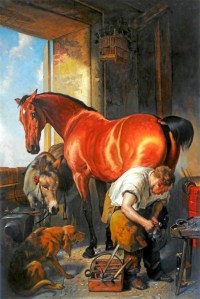
Didst fettle for the great grey drayhorse his bright and battering sandal!  14
Considering the Poem
The poem starts at work. The opening question has a detached, almost offhand tone and seems to have been provoked by a piece of information about Felix Randal given to the poet by a peer, one that presumed knowledge about the death of Randal without making the fact of the death explicit so that a question asking clarification is made necessary (1). This is a language moment typical of everyday communication: a presumption leading to some inexact information, then a question.
In fact, the whole poem could be said to be an exercise in change and variation of tone, each variation related in different ways to the ideas being expressed in the poem.
There are moments of internal reflection, arising from the actions of work, when the poet is addressing himself. He draws tersely stated, truncated conclusions that we, as it were, overhear: that his own ‘duty’ is ‘ended’ (1); that ‘Sickness broke’ Randal (5); and then the desultory hope in ‘Ah well, God rest him all road ever he offended’ (8). Hopkins’ more usual tones and language styles also assert themselves when the priest’s brief conclusions develop and expand into the runs of descriptive energy that we associate with this poet. These follow the restrained conclusions.
So, in the opening quatrain, reflecting on what he saw during his visits of pastoral care for the dying Randal, Hopkins communicates awe for the man’s original physical strength and fear in the weakening of Randall’s mind and his body (3) as its elements warred with one another to destroy that health; then, similarly, in the second quatrain, after the summary statement (‘Sickness broke him’ 5), we learn of the farrier’s quiet acceptance of death, a gradual change concluded with the application of the last rites (6). Tonally, we are in a more familiar Hopkins language in these passages; the verse is excited by the odd syncopated rhythms that he specialised in – the unexpected stresses often emphasized with alliteration.
In the last six lines of the sonnet, usually, as here, printed as two separate verses of three lines each (‘tercets’ is the literary term) the poet continues to create light and shade by tonal variation. He first steps back to consider the general effect of the mutual endearing (9) that the pastoral ministrations create in the Randall and the priest. As he moves us forward through the process of the farrier’s death, Hopkins uses the penultimate verse to reach the climax of feeling in the poem: the closeness of the father-priest and son-parishioner is emphasized in the descriptive detail (10-11) and the poet aims, in the affecting simplicity of tone in the emotion and in the halting repetition of ‘’my heart, child, Felix, poor Felix Randal’ (11), to recreate his own loving kindness in our hearts.
In the end, we are not left not in despair. The final image is of Felix Randal, the farrier, in his pride and in the height of his abilities as he works, ‘powerful amidst peers’ (13), to dignify and serve the needs of the huge dray-horse by hammering out its bright shoes.
This image, ending the poem, is what remains of Felix Randal, enduring in our minds.

KINDLE EDITION £1.99 (at time of writing)

PAPERBACK EDITION £5.56 (at time of writing)
 Christian Poetry Considered