

‘No coward soul is mine’ by Emily Bronte (1818-1848)

No coward soul is mine
No trembler in the world's storm-troubled sphere:
I see Heaven's glories shine,
And Faith shines equal arming me from Fear.  4

O God within my breast,
Almighty ever-present Deity!
Life -  that in me hast rest,
As I - Undying Life - have power in Thee!           8

Vain are the thousand creeds
That move men's hearts: unutterably vain;
Worthless as withered weeds,
Or idlest froth amid the boundless main,          12

To waken doubt in one
Holding so fast by thy infinity;
So surely anchored on
The steadfast rock of Immortality.                         16

With wide-embracing love
Thy spirit animates eternal years,
Pervades and broods above,
Changes, sustains, dissolves, creates and rears. 20

Though earth and moon were gone,
And suns and universes ceased to be,
And Thou wert left alone,
Every Existence would exist in Thee.                24

There is not room for Death,
Nor atom that his might could render void:
Thou – Thou art Being and Breath,
And what Thou art may never be destroyed.   28
Considering the Poem
The strength of emotion in this famous poem is so great that it threatens to explode the verse itself and would have done so if Emily Bronte had not held the feeling in shape by formal means.
The poem begins as if the middle of an angry dispute. The speaker – we can assume Emily Bronte herself – starts with what sounds like a fierce retort aimed at a critical listener, perhaps herself.
The emotion is sustained as we are taken through a series of exclamatory addresses to God and then a dismissal of the false belief systems that we might cling to in a storm (9-16), the poem heading to its conclusion through a affirmation of the ‘wide, embracing love’ (17), the animating ‘spirit’ (18) and the absolute permanence of both God and, consequently, of the human soul (21-28). At no point in the verse does the intensity of feeling abate.
The formal orderliness of the familiar quatrain verse form and its repeated pattern of pairs of a longer and then a shorter line do help to control the expression of that passion. There is control, too, at a more detailed level. Editors do different things with Emily Bronte’s punctuation (or lack of it) in this poem but usually it is presented, as here, with six of the seven verses each comprising a single sentence. Also, inside each verse, few of the lines run over into the following line. There is usually, therefore, at least a pause at each line end. These stops and pauses halt, for a moment at least, the headlong run of feeling.
The pressure of feeling in the writing is most noticeable in the first two verses: we see, for example, that the iambic trimeter is no sooner established (in the first line’s simple unstressed-then-stressed, or iambic, pairs of syllables) than it breaks down into the agitated rhythm of the long second line. The rhythmic unpredictability, the sudden exclamations, the sudden changes in direction in the expression of the thoughts marked by the dashes (7-8) all create a sense of danger. Emily Bronte certainly wants to communicate passion and she also wants us to be aware of the risk that the strength of her feeling could destroy the organisation of her verse, especially in these opening stanzas.
From the third verse, the tone and approach changes. She has introduced the main philosophical idea in the poem in the second verse: that God is ‘within’ her and so is ‘ever-present’ (5, 6). She then takes a wider view, replacing passionate subjectivity with a more objective survey of the world and its vain ‘creeds’ (9).
The word ‘creeds’ is obviously an important one, and how we understand it makes a difference to how we understand the whole poem. The ‘creeds’ she describes are ‘worthless’ (11) and cannot, in the end, ‘waken doubt’ (13) in a person who holds fast to the rock of immortality (16). It’s worth noticing that, in this case, we have to get to the end of the sentence in question, not just the end of the verse, to get the full sense.
It is unlikely that Emily Bronte, a Christian here expressing the depth of her faith, is suggesting doubt about the doctrine in the Christian creeds. The word ‘creeds’ is also commonly used to refer to all frameworks of belief, including political and social systems of thought, and she seems to see these as abstractions that, unlike the direct, inner experience she has claimed of the ‘ever-present’ (6) God, are not reliable.
Also, in the end, the essence of her own religious life is not in the cognitive and theological formulations of the creeds but in her intuitive trust and faith in a God ‘within’ (5), immanent in her life, and therefore part of her immediate, concrete experience. Her direct knowledge of God, unmediated even through words, makes ‘doubt’ (13) impossible for her.
She scans the world and sees, in her excitement, God’s animating power everywhere (20-24); then, in fear, she looks into an extreme future, imagining a time when that animation and energy has drained from the universe and nothing is left: the ‘suns and universes have ceased to be’ (22). But what she does not find in her imagined end time is an absence of God.
St Paul said that in God, ‘we live and move and have our being (Acts 17: 28) and because God abides in us and we abide in Him, and what He is ‘may never be destroyed’ (28), the logic of Emily Bronte’s argument is that, since God would continue to exist even in the nothingness of an unwound and empty universe, everything ‘would exist’ (24) in Him, contained in His ‘Being and Breathe’ (28) – rather like her own spiritual energy is, here and now, contained and shaped in her own passionate but controlled poem.
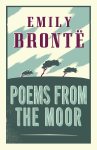
KINDLE EDITION £3.99 (at time of writing): Poems from the Moor (Alma Classics) eBook : Bronte, Emily: Amazon.co.uk: Kindle Store
PAPERBACK EDITION £7.35 (at time of writing): Poems from the Moor (Alma Classics): Emily Brontë: Amazon.co.uk: Emily Brontë: 9781847497246: Books
 Christian Poetry Considered