

‘Lord, when the wise men came from afar’ by Sidney Godolphin (1610-1643)
Lord, when the wise men came from far
Then did the shepherds too rejoice,
Instructed by thy angel’s voice,
Blest were the wise men in their skill,
And shepherds in their harmless will.   5

Wise men in tracing Nature’s laws
Ascend unto the highest cause;
Shepherds with humble fearfulness
Walk safely, though their light be less:
Though wise men better know the way
It seems no honest heart can stray.    11

There is no merit in the wise
But love, the shepherds’ sacrifice.
Wise men all ways of knowledge past,
To the shepherds wonder come at last,
To know, can only wonder breed,
And not to know, is wonder’s seed.   17

A wise man at the Alter bows,
And offers up his studied vows,
And is received. May not the tears,
Which spring too from a shepherd’s fears,
And sighs upon his frailty spent,
Though not distinct, be eloquent?     23

‘Tis true, the object sanctifies
All passions which within us rise,
But since no creature comprehends
The cause of causes, end of ends,
He who himself vouchsafes to know
Best pleases his creator so.           29

When then our sorrows we apply
To our own wants and poverty,
When we look up in all distress
And our own misery confess,
Sending both thanks and prayers above,
Then, though we do not know, we love.   35
Considering the Poem
There are two different accounts of the nativity of Jesus in the gospels. In Matthew’s gospel, Herod sends three wise men to discover the birthplace of Jesus so he can receive a report from them that would help him decide how much of a threat to his own power this child might become.
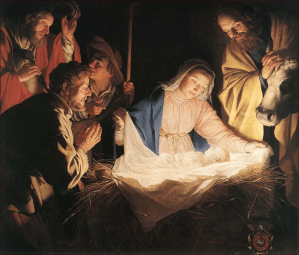
There are no shepherds in Matthew’s version. They appear only in Luke’s gospel in which three local shepherds are told by an angel to travel into Bethlehem to find the child lying in a manger who is to be their saviour. As do many paintings and illustrations of the nativity scene, Sidney Godolphin combines the two versions into one compound story and, in doing so, brings into the foreground for our attention something very important about Christianity.
When we look at the way each of the verses is organised, we can see that Godolphin is keen to contrast one group of visitors with the other when making the compound account. Each of the first four verses comprises a contrast between the shepherds and the wise men; then, the last two verses bring the shepherds and wise men together, emphasising what they share. He does not re-tell the whole stories from the gospels; he is more interested in the approaches to life that the two groups represent.
The wise men are learned men. Their core virtue is knowledge. They are what we might call cognitive types, and the poet emphasises this in every detail of his account of them: the words ‘know’ (10, 16, 17), and ‘knowledge’ (14) are attached to them; we hear of their ‘skill’ (4) and of their ‘studied’ (19) vows at the altar. They devote themselves to an attempt to think and reason their way to some final explanation of what life is for by tracing ‘Nature’s laws’ (6) and reaching with their minds into the ‘highest’ (7) questions about life in the world. They are not being criticised for this. They are ‘Blest’ (4) in their skills of rational enquiry.
We gradually realise, though, that Godolphin wants us to sense the limitations of abstract thought and rational enquiry. The wise men are not going to succeed: understanding – even wisdom – cannot suffice because ‘no creature comprehends/The cause of causes, end of ends.’ (26-27). Something more (or different) is needed for that and, at each point in the unfolding of the poem’s argument, it’s the shepherds, despite their small learning and humble work, who show us what the wise men lack.
They have virtues that do not depend on intellect or sophisticated learning. They intend no ill to anyone (5); they walk safely on their journey to the manger without the wise men’s educated ‘light’ to guide them (9); they each have an ‘honest heart’ (11). Most importantly, they have something that no amount of book-learning can provide. They have ‘love’ (13) and this love is the ‘sacrifice’ (13) or gift they will offer to the Christ child. They have, too, the capacity for ‘wonder’ – a word so important to the poem’s argument that Godolphin repeats it three times in as many lines (15-17).
Their gifts of wonder and love do not make the shepherds superior to the wise men, but their ‘tears’ (20) of awe and humble fear are, even if they are less exact than the words of the schooled wise men, as ‘eloquent’ as the correct vows of their social and educational superiors. In a way, it is easier for them. The wise men, the poet says, have to achieve what the shepherds know instinctively, intuitively and emotionally: ‘Wise men, all ways of knowledge passed,/To the shepherds’ wonder come at last’ (14-15).
There are things we do not know and cannot know. But there are also things we can see and understand, Our lives, Godolphin seems to think, offer us a way to understanding through love. What we must do, therefore, is to offer ‘thanks and prayers’ (34) and accept that ‘though we do not know, we love’ (35). This resonant conclusion, perhaps the central idea of Christianity, is embodied in the poor and simple shepherds.
For Godolphin, being clever is not the main thing.

The New Oxford Book of Seventeenth Century Verse
 Christian Poetry Considered