

‘In Memoriam: 106′ by Alfred Tennyson (1809-1892)

Ring out, wild bells, to the wild sky,
   The flying cloud, the frosty light:
   The year is dying in the night;
Ring out, wild bells, and let him die. 4

Ring out the old, ring in the new,
   Ring, happy bells, across the snow:
   The year is going, let him go;
Ring out the false, ring in the true. 8

Ring out the grief that saps the mind
   For those that here we see no more;
   Ring out the feud of rich and poor,
Ring in redress to all mankind. 12

Ring out a slowly dying cause,
   And ancient forms of party strife;
   Ring in the nobler modes of life,
With sweeter manners, purer laws. 16

Ring out the want, the care, the sin,
   The faithless coldness of the times;
   Ring out, ring out my mournful rhymes
But ring the fuller minstrel in. 20

Ring out false pride in place and blood,
   The civic slander and the spite;
   Ring in the love of truth and right,
Ring in the common love of good. 24

Ring out old shapes of foul disease;
   Ring out the narrowing lust of gold;
   Ring out the thousand wars of old,
Ring in the thousand years of peace. 28

Ring in the valiant man and free,
   The larger heart, the kindlier hand;
   Ring out the darkness of the land,
Ring in the Christ that is to be. 32
Considering the Poem
As we have seen here before, Tennyson’s ‘In Memoriam’ began as a response to a friend’s untimely death but grew into an intense and wide-ranging investigation of faith, the apparent cruelty of nature and of the meaning – and possible meaninglessness – of life itself. Not much escapes Tennyson’s scouring inquisition of life. He goes up to the edge of life and he looks into darkness, scanning it for signs of a further truth.
This famous Christmas and New Year poem uses the same verse form as all the poems in the sequence. The rhyme scheme, in which the last line always rhymes with the first, creates a cyclical movement in each verse as it dwindles and draws back into itself, ending in a moment of stasis. The mood of this poem, however, is charged with prophetic exhortation.
This poem’s subject is the turning of the old year into the new, that point of each year at which we all feel we shall be able to start again and do better. It comes late in the sequence of 131 poems and is a signal of the moral and spiritual recovery which the poems of ‘In Memoriam’ finally discover.
The poem broadcasts a loud rallying call to new life, hope and faith. It works by using the simple, strong devices of repetition, contrast and accumulation to create an unusually intense tone of voice. Tennyson entreats us (and, probably, himself) again and again to ‘Ring out’ the old. When he first uses the phrase in the first verse to jump the poem into life, it just refers to the bells’ releasing of streams of sound into the air but, by the start of the second verse, the exhortation ‘Ring out’ has acquired an ambiguity: it now also means ‘get rid of’ or ‘expel’ so the rest of the poem becomes an accumulating list of evils that we must eliminate and, through the contrasting voice that speaks of what we must ‘Ring in’, a list of what, in each case, must replace those evils.
The two simple rhythmic appeals are repeated many times at the start of each entreaty – an example of the rhetorical device of anaphora – so they themselves peal like the church bells in the poem, reaching a climax in the seventh, penultimate verse in which the old is rejected, and in the last verse in which a new world, not just a new year, is promised.
Christianity assumes that to improve our social and moral lives we must first improve ourselves. In the context of this assumption, exhortation makes sense because our own natures are the only thing that we can all control. Because Tennyson assumes that our behaviour, and the societies we create, are conditioned by weaknesses of our inner nature, the list of evils includes large numbers of moral and spiritual weaknesses that can cause wider social ills, large and small: will-sapping grief, envy, hostility, faithlessness, arrogance of position, cupidity and pride.
The poem reaches a climax in a vision of a new world of free, courageous individuals in a land that has the power to exclude ‘darkness’ because it is made from the ‘Christ that is to be’ , the infinitive form of the verb indicating a permanent and true state of existence (32).
Tennyson, interestingly, includes his own ‘mournful rhymes’ (19) in the accumulated list of evils and, of course, although the mournful rhymes are designed here to change the world by persuading us to change ourselves, they are a product of the world’s illness and confusion. As Tennyson stands on the very edge of the new year, he reminds us of a further truth: that it is possible to find renewal and a new being in Christ.
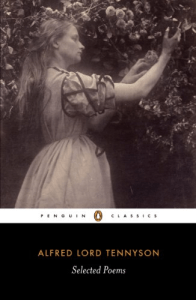
Selected Poems of Alfred, Lord Tennyson (Penguin)
 Christian Poetry Considered