

‘The Rhodora’ by Ralph Waldo Emerson (1803-1888)
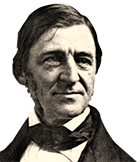
On being asked, whence is the flower.

In May, when sea-winds pierced our solitudes,
I found the fresh Rhodora in the woods,
Spreading its leafless blooms in a damp nook,
To please the desert and the sluggish brook.  4

The purple petals fallen in the pool
Made the black water with their beauty gay;
Here might the red-bird come his plumes to cool,
And court the flower that cheapens his array.  8

Rhodora! if the sages ask thee why
This charm is wasted on the earth and sky,
Tell them, dear, that, if eyes were made for seeing,
Then beauty is its own excuse for Being;   12
Why thou wert there, O rival of the rose!
I never thought to ask; I never knew;
But in my simple ignorance suppose
The self-same power that brought me there, brought you. 16
Considering the Poem
Sophisticated as they may sometimes be, poems are also practical things. They have to communicate the basic, concrete circumstances on which they are based so that we are able to grasp the who, what, when and where facts as easily as possible. It’s surprising how often a writer’s failure to provide these basic, hard facts fully and clearly causes frustration or misinterpretation .
In a narrative poem, the circumstances are usually communicated to us explicitly; we are told (not just shown) the answers to the basic questions. Lyric poems like this one, because they depend on seeming to be a natural and spontaneous flow of thought and feeling, often need to communicate this kind of information by implication. We have to work out the answers but it’s an important (and underestimated) part of a lyric poet’s work to make our interpretative task as smooth and natural as possible by communicating the facts of the imagined situation without allowing clumsily handled, clunking detail to break the poem’s spell.
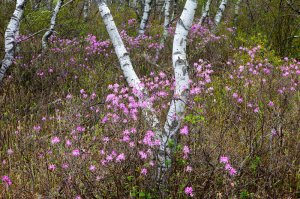
Here, because there’s no evidence to the contrary, we’re inclined to think the speaker is Emerson himself. He talks about ‘our solitudes’ (1) so we assume he has been in company and that his friends and he have become mentally disconnected, one from the other, by their individual thoughts and reflections. Emerson leaves the company in their sea-side location and walks into the woods. There he is transformed and enlivened by a discovery.
The Rhodora is a flowering shrub, native to North America and commonly found, exactly as here in the poem, in ‘damp’ (3) and secluded woodland. Unlike the blazoning rose with which it is contrasted (13), it is not much celebrated in art or poetry. It is a modest plant. Emerson tells us it is noticed only by the wild woodland and the ‘sluggish brook’ by which it is grows (and by Emerson himself, of course!). All this information is given skilfully and unobtrusively in the first four lines, or quatrain, of the poem.
The second quatrain, again comprising a single sentence (5-8), develops our ideas and feelings about the natural context and character of the flowering shrub. The focus changes here, though: the poet uses the second quatrain to impress on us the beauty of the flower by concentrating our attention on its colour, particularly, which outshines the plumage even of the visiting red bird. The visualisation of the plant reaches a climax in the strange image of its ‘purple petals’ in the pool of ‘black water’ (5-6). Of course, water in a shady spot does look black so the image does have a practical point in its observational accuracy. But so strong is the image of colour, vitality and beauty in darkness that it also has a symbolic quality.
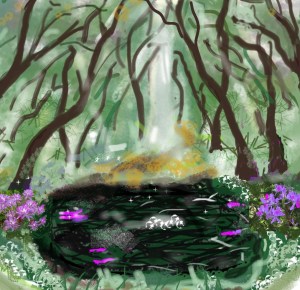
At this point Emerson begins to change and heighten the mood of the poem, quietly shifting away from exposition, narration and visual description.
The two opening quatrains each end with a rhyming couplet to help us see the organisation of the poem and to prepare us to expect something new in the final eight lines (in literary language, an octet) of the poem. What this turns out to be is a concluding and climactic episode of reflective writing. The poet begins this with the direct address to the rhodora that starts with the first word of the octet. Emerson draws out two truths during the reflection.
Firstly, that, though the humble shrub may be hidden in the damp, gloomy wood, its ‘charm’ (10) is not wasted. The word ‘charm’ is not being used with what is nowadays its association of superficial prettiness. Emerson means us to understand the deep, magical idea of enchantment. It is not wasted because ‘beauty is its own excuse for Being’ (12). The insignificant plant has caused (5-6) a moment of imaginative intuition because it embodies clearly, though hidden as it is in the wood, the fundamental Christian virtues of humility and modesty. In its being, it is the opposite of the worldly rose.
Secondly, for Emerson, it seems to be part of the coherence of the insight that it did not happen by accident. During this short poem, something is reconciled or fulfilled. The social disconnection with which the poem begun is now replaced by connection as he sees into the life of things through the glassy image of a petal in dark water. The question which forms the poem’s subtitle is now answered. More importantly, in terms of the view of life that the poem incorporates, the ‘self-same power’ (16) that brought the rhodora to that spot in the woods also brought Emerson.
Life, in other words, Emerson seems to imply, makes sense: what may appear an accident arising in the chaotic and random flux of life’s events has significance and meaning that are produced by God’s unfolding will and that can, in some odd, unplanned and unpredictable moments, be fleetingly perceived.
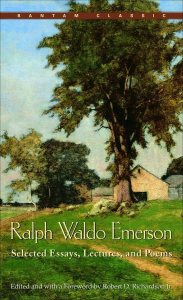
Ralph Waldo Emerson ‘Selected Essays, Lectures and Poems’ (Mass Market Paperback)
 Christian Poetry Considered