

‘The Seas are Quiet’ by Edmund Waller (1606-1687)

The seas are quiet when the winds give o’er;
So calm are we when passions are no more.
For then we know how vain it was to boast
Of fleeting things, so certain to be lost.
Clouds of affection from our younger eyes
Conceal that emptiness which age descries.  6

The soul’s dark cottage, batter’d and decay’d,
Lets in new light through chinks that Time hath made:
Stronger by weakness, wiser men become
As they draw near to their eternal home.
Leaving the old, both worlds at once they view
That stand upon the threshold of the new. 12
Considering the Poem
Sometimes, as we reach old age, we become frightened and sometimes we may, as does Edmund Waller here, gain peace in looking back to see how, the storms of youthful feeling passed, the soul may find calm and enlightenment even while the body weakens and breaks.
The general organisation of the poem – its two verse structure with the first dominated by images of the sea and the second dominated by images of land (and the detailed organisation of the thought in couplets) – share a principle of design that could be described as binary: sea and land, youth and age, turbulence and calm, light and dark, permanence and impermanence, noise and quietness. These balancing antitheses embody in verse the steady perspective the poet has achieved in his old age.
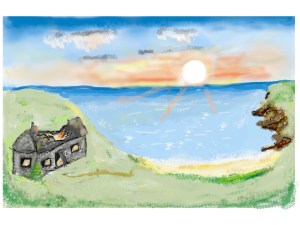
The first verse holds together around the central image of a sea, rough then smooth, stormy then calm. The verbal integrity of the verse arises from the way the marine and weather imagery is developed as we move through the couplets: the affections and ‘passions’ (2) of youth are turbulent ‘winds’ (1) and then like scudding ‘clouds’ (5) that obscure their own insignificance until the wisdom of older age perceives the ‘emptiness’ (6) they have covered up.
The second controlling image in the poem, introduced in its first line of the second verse, is of a cottage, standing for the speaker’s body, part ruined by age. This image, too, is developed. The cottage is ‘batter’d and decay’d’ (7); it is contrasted with the eternal ‘home’ on whose ‘threshold’ (12) the speaker stands; ironically, also, in its very dilapidation, the ‘dark’ (7) cottage lets in the ‘new light’ shining down from a soul’s permanent home in heaven.
At a more detailed level, the couplets each have a binary and often antithetical form. Each element of the poet’s thinking is fully encapsulated within the strict limits of a couplet. There is a strong stop at the end of each two-line unit of sense and, if you read the couplets consciously, you also see that the two lines have an inner balance, the first of the pair leading you out into a thought and the second line in the couplet reaching a point of rest by completing that thought. The couplets are like a brief journey that take us from the start to the completion of a single thought.
Waller is looking back at his life from the vantage point of age. Although he describes the passions of youth, he does not want the poem to be turbulent in its tone, mood or organisation. He wants it, not just in its images and words but in its style and form, to communicate a sense of an old man’s wisdom. The condensed, intensely managed couplets help him to convey a sense of control and repose.
Waller even controls the musical qualities of the verse to embody the lenitive calm that age has brought. The rhyming couplets provide a regular music and the metre of the poem is the familiar iambic pentameter of English poetry, with each line being made from five units of two syllables, the first of the pair unstressed and the second, stressed.
Waller presents old age as a beneficial time. Our passions and pride about insubstantial and transitory achievements abate and the attachments that cloud our younger eyes are revealed in their inner emptiness by the discernment of a mind looking back from old age, looking, in terms of the imagery here, across a quietening sea (1).
The Christian paradox that people become stronger when weak (9-10) and the gift of seeing truly when approaching death lead us into the climax of the verse, embodied in the final thought that, Janus-like, in the precarious extremity of old age, with all passion spent, one has the opportunity to see both before and after as one stands on the ‘threshold of the new’ (12).

Complete Works of Edmund Waller (Delphi: KIndle Edition)
 Christian Poetry Considered