

‘The Windhover’ by Gerard Manley Hopkins (1844-1889)
To Christ our Lord

I caught this morning morning's minion, king-
      dom of daylight's dauphin, dapple-dawn-drawn Falcon, in his riding
      Of the rolling level underneath him steady air, and striding
High there, how he rung upon the rein of a wimpling wing 4
In his ecstasy! then off, off forth on swing,
      As a skate's heel sweeps smooth on a bow-bend: the hurl and gliding
      Rebuffed the big wind. My heart in hiding
Stirred for a bird, – the achieve of, the mastery of the thing. 8

Brute beauty and valour and act, oh, air, pride, plume, here
      Buckle! AND the fire that breaks from thee then, a billion
Times told lovelier, more dangerous, O my chevalier!            11

      No wonder of it: shéer plód makes plough down sillion
Shine, and blue-bleak embers, ah my dear,
      Fall, gall themselves, and gash gold-vermilion. 14
Considering the Poem
To be believable about anything more complicated, a poet’s writing has firstly to be correct and accurate about matters of descriptive fact. One of the qualities of Gerard Manley Hopkins’ work is the ease with which he passes this basic test. As anyone who has watched a kestrel in action or, for that matter, looked at ploughed fields in the slanting sunlight of an early morning, the descriptive accuracy of Hopkins’ verse is obvious. He achieves other, higher qualities in the poem, of course, but without the credibility of description at its base, the poem could not either convey the symbolism that is built on that foundation of accuracy or create the excitement of its language and verse style.
The poem is a sonnet, though one almost broken by strong feeling. Most of the first part of the poem, the first eight lines, describe the kestrel, or windhover as Hopkins names the bird, in flight. Three elements of this opening description are exact: firstly, the maintenance for long periods of a still, high position in the air so that the bird can keep a steady focus on its prey below; then, the way, in this windy position that the bird maintains its nearly motionless hover by making continual tiny adjustments by fluttering, or ‘wimpling’ (2-4) to compensate for the changing wind; and, finally, the way the bird can suddenly change position in a wide, looping movement (7-8), like a fast ice-skater, so that, through that controlled letting go, it can in a trice, trace out an arc through the air to get a new perspective on the land below.
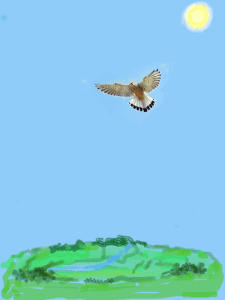
This initial descriptive part of the poem shows us the ‘mastery’ (8) of the animal as it gets itself ready for a sudden, killing descent. The other episode of description is at the end of the poem, in the second half of the six-line (or, sestet) section. There is no reader that is not going to find these lines difficult, because of Hopkins’ use of unfamiliar vocabulary but also because of the sudden change of focus from air to earth. We are now not in the airy world of ecstatic movement. In the ploughed field, people ‘plod’ (12). The ‘sillion’ (12) is the earth banked up by the plough, catching the strong light of morning sun (as the bird hovers above). A ploughed soil with clay in it will, as is described here, sometimes glow as it catches the sun (13-14). But what are the ‘blue-bleak embers’ (13) that Hopkins mentions?
Here, we are taken beyond accurate description towards the climax of the symbolic life of the poem. The embers are the remains of a fire that slip and fall, and cut up in splinters, as suggested by the word ‘gall’ (14). The element of fire has earlier been introduced in the poem (9-11), at the point when the poet is at a pitch of excitement about the bird, the language itself embodying that excitement in compulsive alliteration, asymmetrical, broken rhythms, unpredictable run-on lines (1-2, for example), odd capitalisation (10), and exclamation (10, 11). The centre of this section of the poem is a dangerous and lovely fire that ‘breaks’ (10) from the bird.
Because Hopkins dedicates the poem to ‘Christ our Lord’, we are alert for a possible connection between the kestrel, Christ and the glow of earth mentioned in the final three lines. We are now in a dimension of Christian symbolism that Hopkins has developed from the sonnet’s descriptive exactness. The idea of fire is at the centre of this symbolism.
The fire to which Hopkins refers is the fire of the Holy Spirit, alive in the world. Christ descended, like the windhover, but to bring new life, not death, and, at the end of his worldly mission he left us, in the Pentecostal fire of the Holy Spirit, a permanent gift.
Seeing the bird as an image of Christ explains the symbolism of the final lines. The earth turned by the plodding farmer and his plough glows with the living embers of that Pentecostal fire and the embers grow into the red-gold glow of the royal, heraldic colour, vermillion. Hopkins has drawn a metaphorical and symbolic world from his description of the material world of earth, animal and air and, through this imaginative process, given us an image of a fiery spiritual energy at work in the world he watched.
Further Reading

Gerard Manley Hopkins Selected Poetry (Oxford World Classics)
 Christian Poetry Considered