

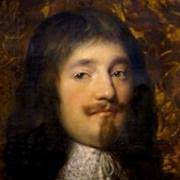
‘They are all gone into the world of light’ by Henry Vaughan (1621-1695)
They are all gone into the world of light!
And I alone sit ling’ring here;
Their very memory is fair and bright,
And my sad thoughts doth clear.   4

It glows and glitters in my cloudy breast,
Like stars upon some gloomy grove,
Or those faint beams in which this hill is drest,
After the sun’s remove.   8

I see them walking in an air of glory,
Whose light doth trample on my days:
My days, which are at best but dull and hoary,
Mere glimmering and decays.   12

O holy Hope! and high Humility,
High as the heavens above!
These are your walks, and you have show’d them me
To kindle my cold love.   16

Dear, beauteous Death! the jewel of the just,
Shining nowhere, but in the dark;
What mysteries do lie beyond thy dust
Could man outlook that mark!   20

He that hath found some fledg’d bird’s nest, may know
At first sight, if the bird be flown;
But what fair well or grove he sings in now,
That is to him unknown.   24

And yet as angels in some brighter dreams
Call to the soul, when man doth sleep:
So some strange thoughts transcend our wonted themes
And into glory peep.  28

If a star were confin’d into a tomb,
Her captive flames must needs burn there;
But when the hand that lock’d her up, gives room,
She’ll shine through all the sphere.  32

O Father of eternal life, and all
Created glories under thee!
Resume thy spirit from this world of thrall
Into true liberty.  36

Either disperse these mists, which blot and fill
My perspective still as they pass,
Or else remove me hence unto that hill,
Where I shall need no glass.   40
Considering the Poem
It’s quite likely that many of us remember a science teacher telling us about the defining characteristics of life and, if we can’t remember, we will certainly have observed for ourselves the importance to life on this planet of things like light, warmth and movement.
The so-called metaphysical poets, of whom Vaughan is certainly one, particularly liked to shock the reader by making odd connections, paradoxical assertions and surprising comparisons. They thought it would wake us up to new perceptions. From the first line and throughout the poem, Vaughan does the unthinkable by connecting our known world with darkness, coldness and restricted movement and connecting the world to come with light, conviviality and free movement.
The arresting paradox is summed up right in the middle of the poem. ‘Dear beauteous Death’, we are told, is ‘the jewel of the just/Shining nowhere but in the dark.’ (17-18). The shine of death is seen in the imagery that Vaughan uses to describe his dead friends’ lives in the after-world. Even the poet’s memory of them is infused with light: in his mind, they are fair and bright (3); they glow and glitter in his thoughts (5); they are ‘like stars’ (6) shining in the gloom of evening. Indeed, while associating his friends with light, he associated his own predicament with isolation and gloom.
It’s interesting that Vaughan seems to place himself very specifically in the poem, on ‘this hill’ (7) at the time of the evening in which the sun sets. This image of the poet isolated in a darkening landscape contrasts with the seeming conviviality enjoyed by his deceased friends. Vaughan In the first verse has described himself as ‘alone’ (2) and, in contrast to the light-infused life of his friends, his life is ‘sad’ (4), ‘dull and hoary’ (11) and its only light is a tremulous ‘glimmering’ (12).
It is not just the contrasting imagery of light and dark around which the poem is built: the friends are also associated with movement while Vaughan’s life here is associated with inertia: he lingers (2); the departed friends he sees ‘walking in an air of glory’ (9) in purposeful, free activity. Their posthumous walks, paradoxically, show him a vision of true vitality (the opposite of what we’d expect) and ‘kindle’ his ‘cold love’ (16).
So, the first half of the poem is built from two radically opposed clusters of imagery: one cluster, crowding around the dead, is to do with vitality, movement, conviviality, warmth and light; the other cluster, related to the left-behind Vaughan, is to do with melancholy, dullness, lassitude, isolation, coldness and gloom. This contrast is carried forward into the final half of the poem, intensifying the upside-down, binary opposition in the imagery that’s been established in the first five verses.
The idea of the bright new life, however, can be based only on ‘holy Hope’ (13) not the certainty of empirical proof. Vaughan uses a set of three images consecutively in verses six, seven and eight, – of the flown bird, of intimations in dreams and of a ‘star confined into a tomb’ – to explore the basis for the hope that a bright new life awaits him when he joins his departed friends in death.
The image in the sixth verse of the flown bird, whose destination we do not – and cannot – know, makes concrete Vaughan’s philosophical point about the limits (or ‘mark’, 20) of our knowledge. If the justification for hope cannot be in certain knowledge, it can, Vaughan tells us, be in ‘brighter dreams’ (25) and ‘strange thoughts’ (27) by which, we may at least ‘peep’ (28) into another, transcendent life.
The most surprising, because most surreal, image is that of the bright star incarcerated in a tomb. It brings to an intense climax the poem’s oppositions between light and dark, between heat and cold, and between movement and inertia: the locked-up star burns brightly in the tight, small tomb but when made free ‘She’ll shine through all the sphere’ (32).
Fittingly and with a sudden change of tone, the poem ends with a prayer and then a petition to God, the ‘Father of eternal life’ (33). Vaughan pleads to be removed from the drifting mists that ‘blot’ (37) his sight here on earth so that he can know liberation from ‘this world of thrall/Into true liberty’ (36). Recalling Paul’s 1st Letter to the Corinthians (13:12) which tells us that we shall, one day, see God face to face and not just, as now, imperfectly through a ‘glass’, the last line of the poem celebrates a liberation from the obscuring ‘mists’ that ‘blot and fill’ Vaughan’s perception, replacing them with a complete and immediate knowledge that is not conveyed through a lens, a pane or a ‘glass’.
This is the benefit of death that Vaughan celebrates and which he explains incrementally through the binary imagery, changes of tone and structural organisation of his poem.
‘Metaphysical Poetry’: An Anthology (Dover Thrift Editions)
 Christian Poetry Considered