

‘In Memoriam: 55 and 56′ by Alfred Tennyson (1809-1892)

Canto  55
The wish, that of the living whole
No life may fail beyond the grave,
Derives it not from what we have
The likest God within the soul?  4

Are God and Nature then at strife,
That Nature lends such evil dreams?
So careful of the type she seems,
So careless of the single life;  8

That I, considering everywhere
Her secret meaning in her deeds,
And finding that of fifty seeds
She often brings but one to bear,  12

I falter where I firmly trod,
And falling with my weight of cares
Upon the great world’s altar-stairs
That slope thro’ darkness up to God,  16

I stretch lame hands of faith, and grope,
And gather dust and chaff, and call
To what I feel is Lord of all,
And faintly trust the larger hope.  20

Canto 56
"So careful of the type?" But no.
From scarped cliff and quarried stone
She cries, "A thousand types are gone:
I care for nothing, all shall go.   4

"Thou makest thine appeal to me:
 I bring to life, I bring to death:
The spirit does but mean the breath:
I know no more."  And he, shall he,  8

Man, her last work, who seem’d so fair,
Such splendid purpose in his eyes,
Who roll’d the psalm to wintry skies,
Who built him fanes of fruitless prayer,  12

Who trusted God was love indeed
And love Creation’s final law-
Tho’ Nature, red in tooth and claw
With ravine shriek’d against his creed-  16

Who loved, who suffer’d countless ills,
Who battled for the True, the Just,
Be blown about the desert dust,
Or seal’d within the iron hills?   20

No more?  A monster then, a dream,
A discord.  Dragons of the prime,
That tare each other in their slime,
Were mellow music match’d with him.  24

O life as futile, then, as frail!
O for thy voice to soothe and bless!
What hope of answer, or redress?
Behind the veil, behind the veil.   28
Considering the Poem
Tennyson’s In Memoriam begins in the wretchedness of mourning and ends, over 130 poems later, in an affirmation, or re-affirmation, of faith. The destination is reached by a protracted and painful process of elegiac and lyrical reflection that develops into a complete re-evaluation of Tennyson’s assumptions about his life and his Christian beliefs as he moves from the faith expressed in the prologue to the work, through undulations of despair, doubt, hope and belief, always hovering in thought close to the possibility that the death of his friend, Arthur Hallam, at the age of 22, might show that the life we lead here is empty of any fundamental significance and meaning.
Matthew’s gospel says that God numbers the hairs on our heads and counts the fall of a sparrow (Matthew 10, 29-31) so why, with omniscience (and complete power), would God allow the apparently senseless death of a young man? It seems like a pointless waste. Perhaps our human lives are just of a series of accidental events – an absurd, tragic farce?

As we can see from these two poems (or, since each is a section of a longer work, cantos), this kind of anxiety was given special intensity for the Victorians by their scientific investigations, most notably for Tennyson, the recent advances in geology. Charles Lyell had published the volumes of his Principles of Geology between 1830 and 1833: his work showed an earth that was formed over aeons by relentless and immense forces of nature. The fossil record was a deposit not just of individual creatures but of whole species that had come into being only to pass into extinction. Although Lyell himself said he perceived a creative intelligence at work in this apparently blind, fumbling process, it was not obvious, at least to Tennyson after Hallam’s death, that a lenient, loving God could be active in nature, at least in an immediate and detailed way. Nine years after Tennyson had finished In Memoriam, the publication of Darwin’s The Origin of Species (1859) introduced further doubt into older, existing views about the relationships between God, nature and human beings.
The two poems here conduct a single argument so are best looked at together. The first takes us through the exposition of the argument. Because Tennyson is writing poetry, he uses the full range of musical, dramatic, figurative, verbal, tonal and structural devices to engage us in his train of thought. The prevailing tone in the poems is personal, almost intimate: he speaks informally to us about matters of extreme and immediate importance to him. He is sharing his private world with us. Having established that we – all of us – ‘wish’ (55, 1) that life continues in some way ‘beyond the grave’ (55, 2) and that this hope arises from the immaterial part of us, the soul, and its connection to God (55, 3-4), he moves swiftly to a concise statement of the poems’ first existential problem: ‘Nature’ (55, 6), even though it seems to preserve species, appears to be ‘careless of the single life’ (55, 8) and works on the principle that from fifty seeds, only the success of one is needed to sustain the plant.
Nature, it seems to Tennyson, not only tolerates but also presumes the waste of individual seeds, animals and, perhaps, even men and women – even his friend Hallam. This is not what Tennyson had read in Matthew’s gospel. In contradiction to Matthew, ‘God and Nature’ seem to be ‘at strife’ (55, 5). The tone of the 55 canto darkens in its final two verses as Tennyson turns his face to the reader to confess his torment, now not just about Hallam’s death but about the meaninglessness it implies. The change of tone is effected by the simple device of speaking directly to us in the first person singular. ‘I falter’ (55, 13); ‘I stretch lame hands of faith’ (55, 17); ‘I feel’ (55, 19). This is not an intellectual problem. It is a crisis of trust in life itself.
Canto 55 ends with an image of a lonely climb towards God, up steps towards an altar and through the dark – a little, hopeful journey, soiled by the ‘dust and chaff’ of the world and its doubts, but terminating only in a ‘faint trust’ (55, 20) that God has a larger design that can be understood. By being communicated as a personal address to the reader and by its careful structuring as it moves through episodes of deepening despair, the argument is given a dramatic, even theatrical, quality.
In canto 56, the slight hope with which the previous poem had ended is destroyed. The poet begins in shocked realisation, seeing that even the meagre fragment he’s managed to hold on to – the idea that Nature cares about the ‘type’, or species, even if not about individuals – is also wrong. It is too hopeful. God may seem to be at least ‘careful of the type’ (56,1) but, in fact, is not. The poem then becomes a dramatic, hostile confrontation between Tennyson and a careless Nature, ‘red in tooth and claw’ (56, 15). Tennyson speaks (56, 1-2): a personified Nature replies with a contemptuous retort (56, 3-8), illustrating the awful truth in the fossils of extinct species exposed in the vertical cross section of time that’s scarped in the cliffs, and concluding, in a tone of dismissive indifference, ‘I care for nothing, all shall go’ (56, 4).
So this indifference must surely apply also to the crown of creation, the human being? But Tennyson knows we are, at least sometimes, ‘fair’ (56, 9), animated by ‘splendid purpose’ (56, 10), ready to offer unanswered prayer (56, 12), and certain that ‘love’ is ‘Creation’s final law’ (56, 14). He has to confront the jarring dissonance of indifference and spiritual striving that seem to him to co-exist in our lives. At this point in the slow, sad progress that In Memoriam makes, he concludes that we will end in nothing, fossilized in the cliffs and rocks or blown as dust, randomly this way and that, a blank as extinct as the violent, stupid and ugly prehistoric beasts that went before us (56, 21-24). In these images, Tennyson taken us to the edge of the bleakest possible view of human existence in which all is for the worst in the worst of all possible worlds.
As we have seen before, the verse form of the In Memoriam poems is special to Tennyson’s purpose; by rhyming the first and last of the four lines and then repeating the rhyme scheme again and again in each verse, the poet communicates, in the music of the poetry, a sense of sustained indeterminacy that’s just right for his subject matter and its mood. Canto 56 does end with a hope, though perhaps not, at this stage in the sequence of poems, a very robust one.
In terms of argument, it reaches that point of hope by abandoning the idea that we can ever understand God through a proof provided by the physical world or a scientific investigation of Nature, and by treating the attempt to do that as what philosophers call a category error – in this case a categorical mismatching of scientific evidence and spiritual conclusions. Nature cannot tell us about God. But In Memoriam will end in confidence in the existence of ‘One God’ that ‘ever lives and loves’ and in a ‘one far off divine event,/To which the whole creation moves’ (131, 141-144).
Less than half way through the poetic investigation, though, Tennyson has not yet secured that confidence. The conclusion to the argument in these two poems is more delicately stated and more tentative. We must, Tennyson concludes, acknowledge mysteries that we cannot explain, and use our human gift for the holistic, intuitive insight that’s found in ‘faith’ (55, 17), ‘hope’ and ‘trust’ (55, 20) to be assured, as Jesus asked the disciple Thomas to do, without physical proof in the natural, objective world (John 20, 29), that one day ‘face to face’ (1 Corinthians 13, 12) we will know what is very close to us but out of reach in that holiest place ‘Behind the veil, behind the veil’ (56, 28).
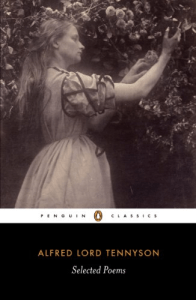
Selected Poems of Alfred, Lord Tennyson (Penguin)
 Christian Poetry Considered