

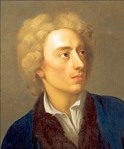
‘Essay on Man’ (extract from Epistle 2) by Alexander Pope (1688-1744)
Know then thyself, presume not God to scan;
The proper study of mankind is man.
Plac'd on this isthmus of a middle state,
A being darkly wise, and rudely great:
With too much knowledge for the sceptic side, 5
With too much weakness for the stoic's pride,
He hangs between; in doubt to act, or rest;
In doubt to deem himself a god, or beast;
In doubt his mind or body to prefer;
Born but to die, and reas'ning but to err;   10
Alike in ignorance, his reason such,
Whether he thinks too little, or too much:
Chaos of thought and passion, all confus'd;
Still by himself abus'd, or disabus'd;
Created half to rise, and half to fall;    15
Great lord of all things, yet a prey to all;
Sole judge of truth, in endless error hurl'd:
The glory, jest, and riddle of the world!
Considering the Poem
Christian devotional poetry of the kind that had been made during earlier centuries (and was to be made in later times) was not, during the 18th century, a preoccupation of the very best writers. Their attention had turned to classical forms and subjects, to Enlightenment values that emphasised the powers and limits of human reason, and to a critical, often fierce, social engagement with the politics, manners and economics of their times and led writers like Pope, Swift and Dryden before them to satire and to other socially and politically engaged writing.
The Christian poetic impulse did not disappear, however. It just migrated into other forms, particularly into hymn writing which, because hymns are made for collective, public performance rather than for the exploration of private, individual ideas and emotions, enriched religious culture with a valuable but different kind of verse.
The verse here is an extract from one of Alexander Pope’s long poetic essays, The Essay on Man, the aim of which was no less than a complete investigation of our proper relations with God, nature and ourselves.
Modern readers often find the mere sight of Pope’s verse, running like verbal canals down page after page, forbidding. But sliding away from the poetry for a superficial reason is a mistake. It entails missing some of the cleverest, brightest and most beautiful writing ever done using the English language.
Here, Pope makes a single argument. He explains to us our dual nature as a being who is ‘a little lower than the angels’ (2 Hebrews, 7; Psalm 8, 5) but higher than the animals below us in the great chain, or hierarchy, of beings. We are precariously placed in creation on what Pope calls an ‘isthmus of a middle state’ (3) at the junction of the material and spiritual worlds, sharing characteristic of both: we are mixed beings, capable sometimes of reason, as Pope’s friend, Jonathan Swift, explained, but not reliably reasonable. Pope has a didactic aim so the passage has an authoritative tone from the opening, ringing admonition, ‘Know then thyself, presume not God to scan’ (1).
Because we are, peculiarly in the chain of creation, in this unstable ‘middle state’ (3), created ‘half to rise and half to fall’ (15), we must avoid excesses of enthusiasm or abstraction. We have ‘knowledge’ but also weakness (5-6); we are uncertain about our own ambiguous, partly divine and partly carnal, nature (7-8, 9-10); we have a latent rationality but use it to make poor decisions (9-10, 11-12), leading us into chaotic states of thought and feeling which, though we are able sometimes to correct ourselves, are frequently the source of our own misuse of ourselves and of others (13-14).
We will certainly not understand God (or our special predicament) using our sporadic and unreliable powers of thought. If however we understand our paradoxical nature, Pope’s argument goes, we will be deterred from wasting our time trying to understand and reason about the exact qualities of God and other abstruse mysteries far beyond our cognitive reach.
Pope is writing in iambic rhyming couplets. We read his work effectively when we read slowly in couplets, consciously assessing each pair of lines for its qualities. These heroic couplets, as they are called by scholarly people, offer particular possibilities for a poet: each pair of lines has its own rhythmic, musical and cognitive identity. As we read, we see how the first and the second line in each couplet function as one, often the second bringing home to a conclusion a thought begun in the first line and thus leading the couplet to rest before the next miniature forward movement begins with the following couplet. Within each line, also, we notice the balance of syllables and rhythmic pulses organized around the short pause, or caesura, near the middle of the line.
It’s worth reading the couplets carefully as units of sense and verbal music because each has the artistic virtues of regularity, balance, proportion, restraint, control and refinement that Pope knows we must acquire in our moral and intellectual lives. So, the classical aesthetic virtues in the form of his verse are the same as the moral and intellectual virtues we must, he believes, strive for in our moral and intellectual lives. The form and style of Pope’s work, here and elsewhere, is part of its meaning: what he advocates as virtues and strengths in life, he practises in his craft.
We are a paradox of being: ‘The glory, jest, and riddle of the world!’ (16). Because of this mixed nature, we are uncomfortable and uncertain so humility and restraint are necessarily required.
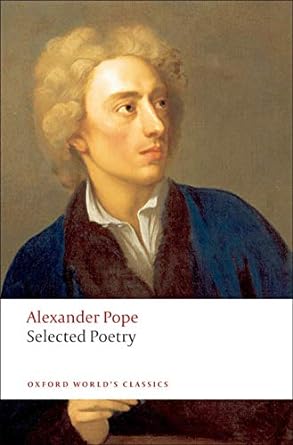
Alexander Pope Selected Poems (Oxford World Classics)
 Christian Poetry Considered